HyperVision Ablation
Harnessing ML for laser ablation assessment in hyperspectral imaging
Highlights
The Institute for Image Guided Surgery in Strasbourg needed to automate evaluation of laser-induced tissue damage from hyperspectral imaging during surgical procedures.
Build an ML workflow to detect and segment ablation zones in hyperspectral imaging data.
Used PCA and t-SNE for feature reduction, Faster R-CNN for detection, and Mean Shift for unsupervised segmentation.
Delivered a robust pipeline enhancing diagnostic accuracy and reproducibility across organs, aiding cancer therapy research.
Core Team





Overview
This project advances the application of hyperspectral imaging (HSI) in medical diagnostics by focusing on tissue ablation assessment during laser treatments. Leveraging machine learning techniques, the workflow integrates dimensionality reduction, object detection, and clustering for efficient analysis of high-dimensional HSI data.
Principal Component Analysis (PCA) and t-distributed stochastic neighbour embedding (t-SNE) reveal critical spectral features, while Faster R-CNN accurately detects ablated regions. Mean Shift clustering is employed for precise segmentation of thermal damage zones. The workflow demonstrates robust performance across different organs, enabling automated, reproducible tissue analysis, and offers potential applications in laser cancer therapy and beyond.
Data
The dataset consists of 233 hyperspectral cubes (dimensions: 640 × 480 × 100 voxels) captured during laser ablation experiments on porcine liver, pancreas, and stomach tissues. These hypercubes were acquired using a TIVITA hyperspectral camera with a spectral range of 500–995 nm, encompassing 100 spectral bands for each image.
Data collection was carried out under controlled experimental conditions across three distinct phases:
- •Pre-laparotomy: Baseline measurements before laser application.
- •Temperature escalation: Imaging during laser-induced heating, with recorded temperature thresholds ranging from 60°C to 110°C.
- •Post-ablation: Imaging of tissue post-treatment to assess residual thermal damage.
To ensure spectral accuracy and spatial consistency, the camera was positioned 40 cm vertically above the surgical field, with lighting provided by a 20 W halogen lamp. For spatial referencing, polyurethane markers were placed around the target area. Reflectance and absorbance imaging modes were utilized, providing complementary insights into tissue properties.
Methods
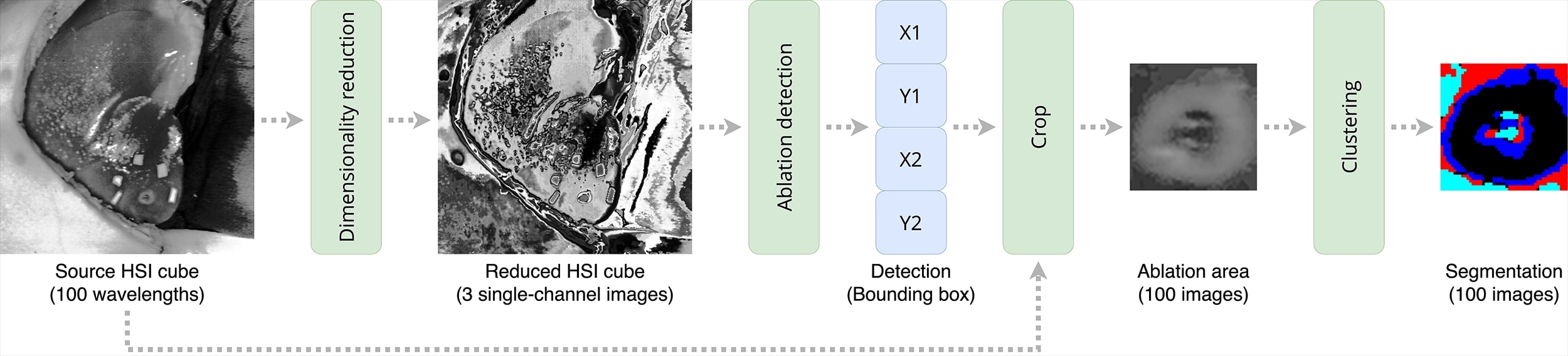
This methodology employed a structured machine learning workflow to analyze hyperspectral imaging data for tissue ablation assessment. The workflow integrated dimensionality reduction for spectral simplification, object detection for ablation localization, and clustering techniques for segmentation of thermal damage zones (Figure 1):
- Dimensionality Reduction: PCA and t-SNE were used to reduce the complexity of hyperspectral data, preserving key spectral features.
- Object Detection: A Faster R-CNN model was trained to detect and localize ablation regions in reflectance and absorbance images.
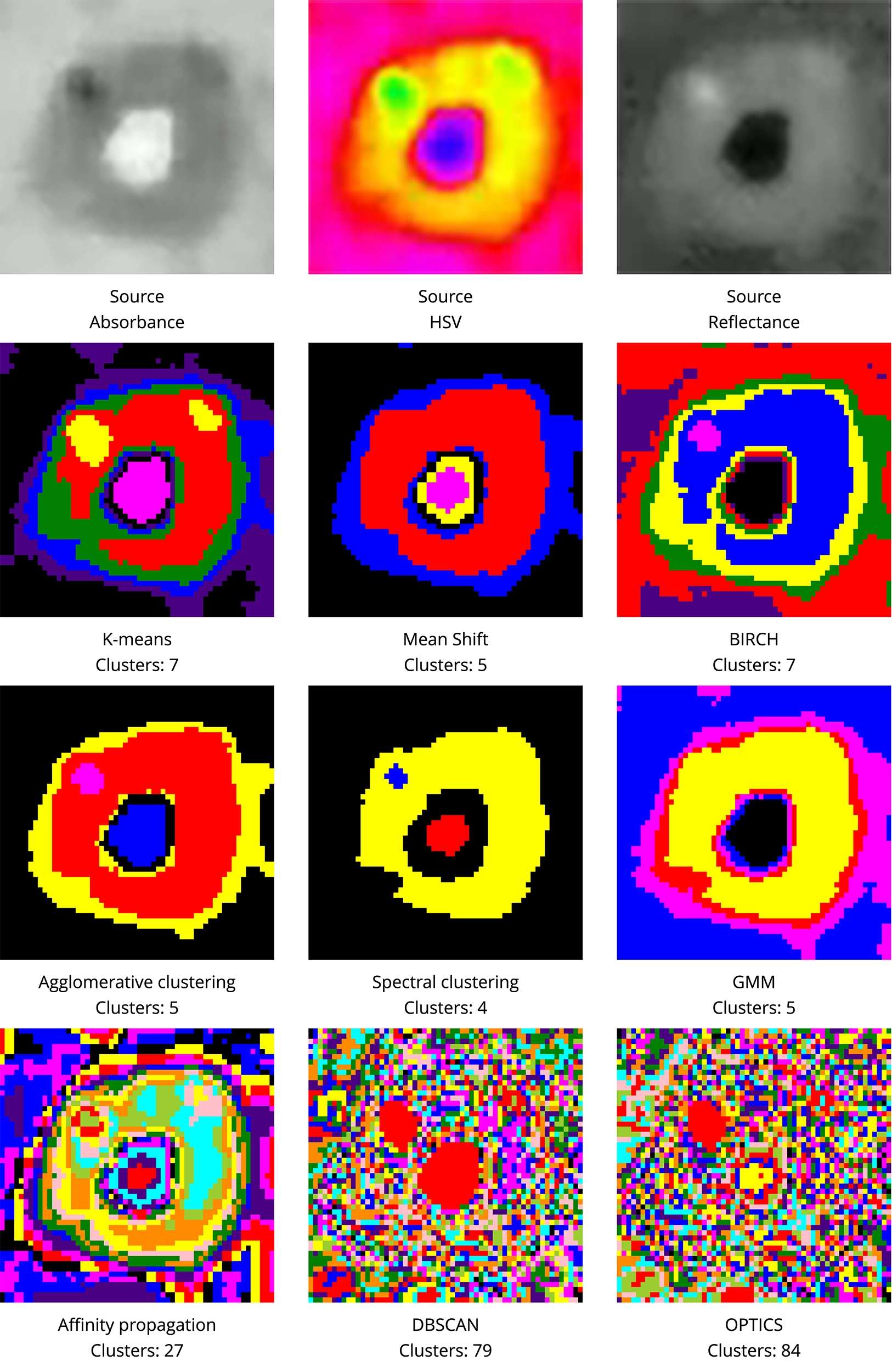
- Segmentation: To segment thermal damage zones in hyperspectral images, multiple clustering algorithms were evaluated, including k-means, DBSCAN, OPTICS, BIRCH, Mean Shift and others. These algorithms were chosen for their ability to handle high-dimensional data and varying cluster characteristics.
Results
The proposed workflow demonstrated strong performance in detecting and segmenting laser-induced ablation regions in hyperspectral images:
- •Dimensionality Reduction: PCA and t-SNE preserved critical spectral features while simplifying high-dimensional data, improving processing efficiency.
- •Object Detection: Faster R-CNN achieved a mean Average Precision of 0.744 on PCA-transformed reflectance data, accurately localizing ablation regions.
- •Segmentation Evaluation: Mean Shift provided the best results, delivering high-quality segmentation without manual input, thanks to its adaptability and noise resilience (Figure 2).
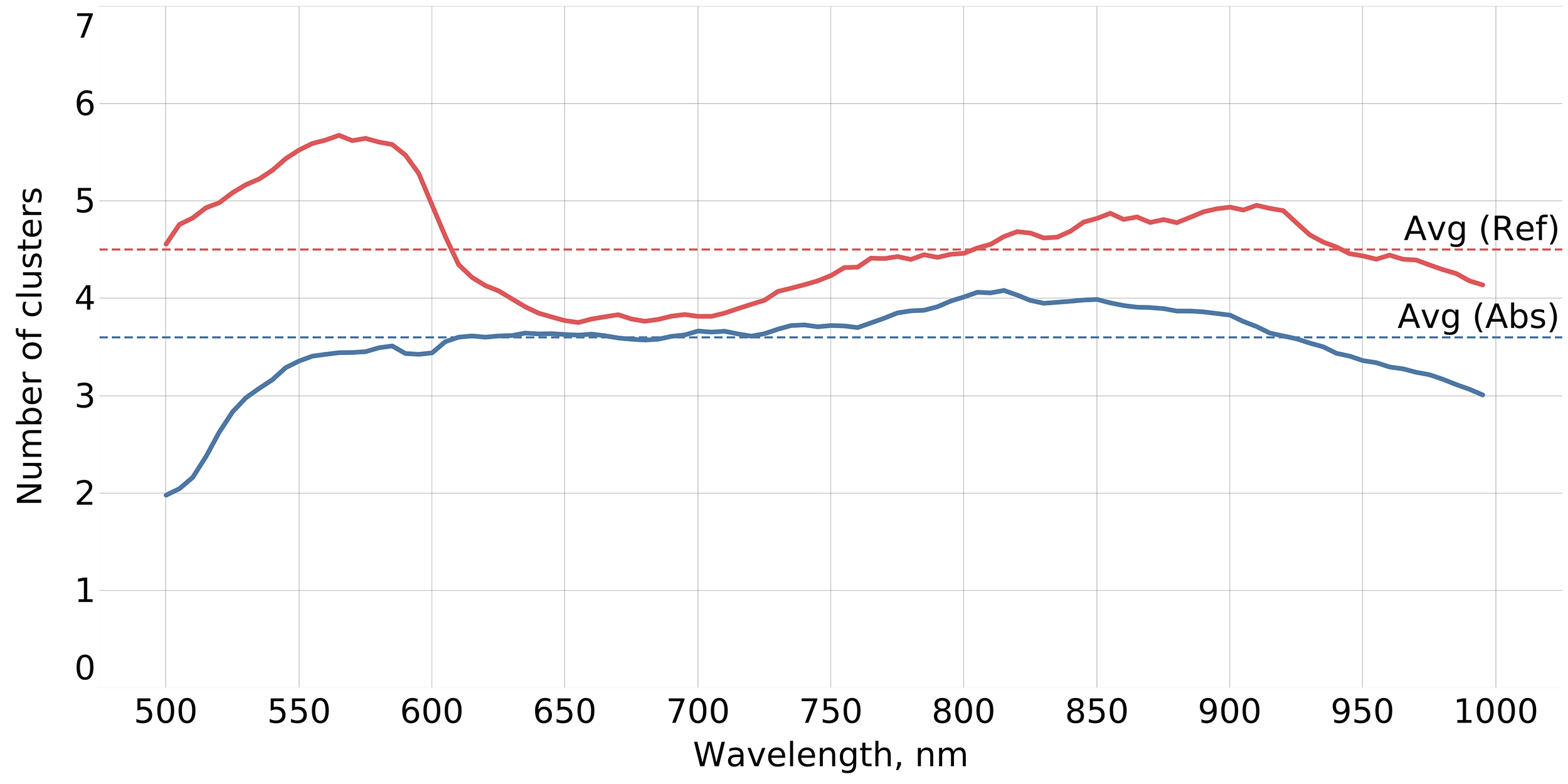
- •Spectral Insights: Cluster numbers varied significantly between reflectance and absorbance modes (Figure 3) due to tissue-specific spectral characteristics and temperature-dependent changes.
Conclusion
This project introduced a robust pipeline for analyzing hyperspectral imaging data to detect and segment laser-induced tissue ablation. Combining dimensionality reduction, object detection, and clustering techniques, the workflow achieved high-quality and automated segmentation.
These advancements have significant implications for medical diagnostics, particularly in laser cancer therapy. Future work could involve refining the pipeline for real-time applications and extending its use to other medical imaging modalities.